
Beyond the Baby Blues: Understanding Postpartum Anxiety in Ontario Mothers

The first few weeks after having a baby are supposed to be exhausting. Everyone says so. You are sleep-deprived, you are healing, you are learning. Feeling tearful, overwhelmed, and not quite yourself in those early days is considered so normal there is even a name for it: the baby blues.
But what happens when the blues do not lift.....?
When the tearfulness is replaced by a quiet, relentless terror — a sense of dread that follows you through every feed and every nap, convincing you that something is about to go wrong? When you cannot stop checking that the baby is breathing? When the worry is so constant that you cannot remember what it felt like not to feel this way?
That is not the baby blues - That is "Postpartum Anxiety" — and it is more common, more distinct, and more treatable than most Ontario mothers realise.
At Reset Counselling & Psychotherapy in Barrie, we want more mothers to know that what they are experiencing has a name — and that support is available.
The Baby Blues: What They Are and When They End
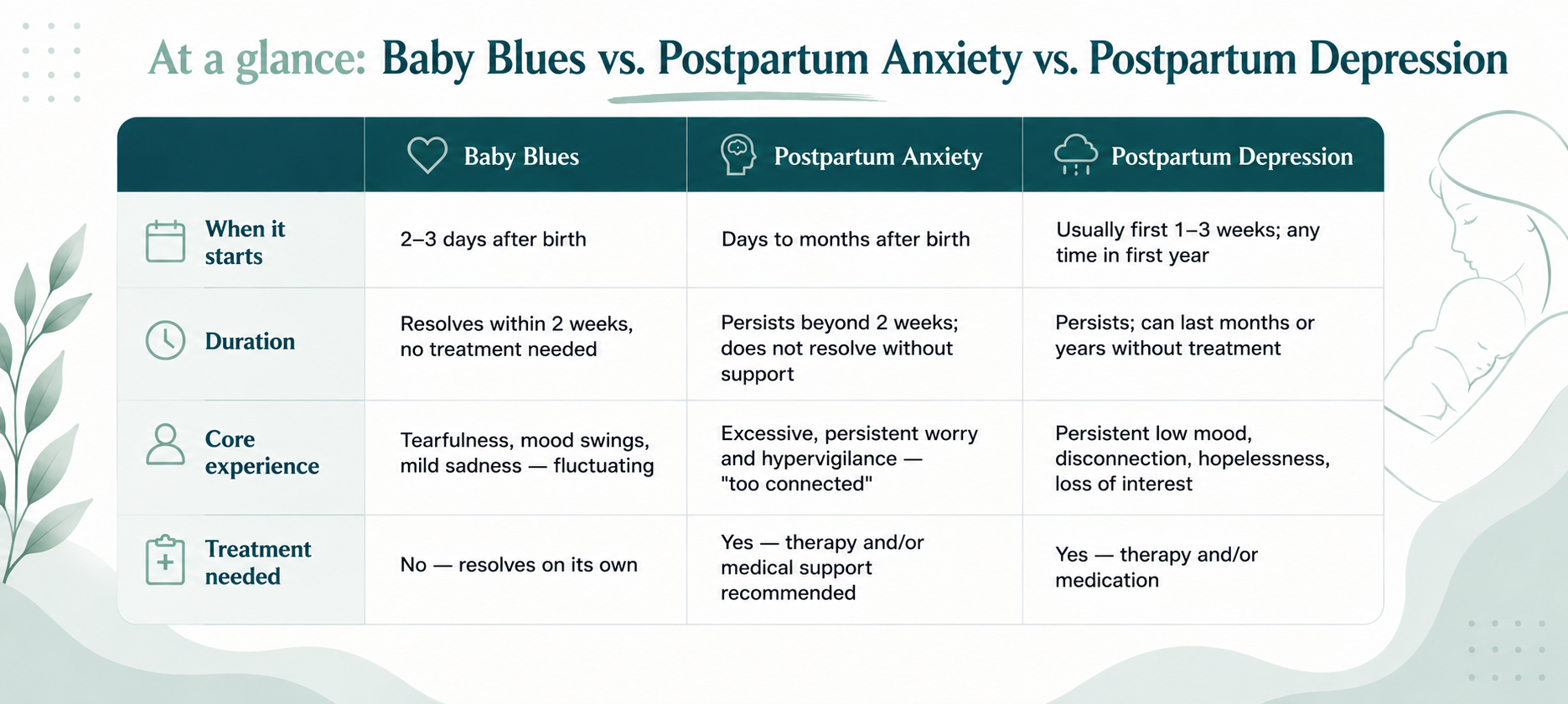
Most new mothers experience the baby blues to some degree. They are a normal, expected response to the dramatic hormonal shift that happens immediately after birth. During pregnancy, estrogen and progesterone reach the highest levels they will ever be in a woman's body. Within 24 to 48 hours of delivery, those hormone levels drop by approximately 90 per cent — returning rapidly to pre-pregnancy levels.[8] This biochemical shift is profound, and the emotional turbulence it causes is not a sign of weakness or illness.
The baby blues typically begin two to three days after birth. They may involve tearfulness, mood swings, irritability, mild anxiety, difficulty sleeping, and a general sense of feeling overwhelmed. Crucially, they tend to resolve on their own within two weeks, as hormones stabilise and the new reality of parenthood begins to settle.
Approximately 50 to 75 per cent of new mothers experience the baby blues. They do not require treatment. Rest, reassurance, and support from people around you are the primary responses. If symptoms persist beyond two weeks — or if they intensify rather than ease — something else may be happening.
Postpartum Anxiety: A Distinct Condition
Postpartum anxiety is often spoken of in the same breath as postpartum depression — if it is spoken of at all. But it is a distinct experience with its own symptom profile, its own causes, and its own treatment needs. While postpartum depression is characterised primarily by low mood, disconnection, and a sense of emptiness, postpartum anxiety is characterised by the opposite: excessive, persistent worry and hypervigilance.
The American Counseling Association describes it as a feeling of being "too connected" — constantly on guard, unable to switch off the monitoring that keeps the baby safe, even when the baby is safe.[7] The worry is typically centred on the baby's wellbeing, but it can extend to everything: relationships, the future, the mother's own ability to cope.
How Common Is Postpartum Anxiety in Canada?
Postpartum anxiety is consistently underdiagnosed — in part because the focus of perinatal mental health screening has historically been on depression, and in part because high levels of anxiety about a new baby can be mistaken for normal new-parent worry.
Data from Statistics Canada's national Survey on Maternal Health, the most comprehensive Canadian dataset on this topic, found that approximately 23 per cent of mothers who recently gave birth reported feelings consistent with either postpartum depression or an anxiety disorder.[1] Research published in the Canadian Journal of Public Health found that 13.8 per cent of Canadian women specifically showed symptoms consistent with postpartum anxiety.[3] These are conservative estimates — the real number is likely higher, given that many women do not recognise what they are experiencing as a condition that warrants support.
The Society of Obstetricians and Gynaecologists of Canada (SOGC)[5], which publishes clinical practice guidelines for perinatal care providers, recognises postpartum mood and anxiety disorders as among the most common complications of childbirth in Canada — and underscores the importance of timely identification and access to care. The CANMAT 2024 Clinical Practice Guideline for Perinatal Mood, Anxiety, and Related Disorders[6] further provides detailed evidence-based guidance for clinicians treating perinatal mood and anxiety disorders across Canada.
Canadian Data
A national survey by Statistics Canada found that approximately 1 in 4 Canadian mothers reported feelings consistent with postpartum depression or an anxiety disorder following birth [1]. A peer-reviewed study published in the Canadian Journal of Public Health (Wong et al., 2020), drawing on data from 6,558 respondents across all ten provinces, found that 13.8% of women showed symptoms consistent with postpartum anxiety specifically [3]. Women with a history of depression were 3.4 times more likely to experience postpartum anxiety symptoms. Social support and sense of community were identified as protective factors.
What Postpartum Anxiety Actually Feels Like
One of the reasons postpartum anxiety often goes unidentified is that the experience can look, from the outside, like a very conscientious and attentive mother. She is checking the baby constantly. She is researching everything. She is always alert. To those around her, it may not look like a problem. To her, it feels relentless.[12]
Postpartum anxiety can include some or all of the following:
- Constant, intrusive worry about the baby's safety, health, or wellbeing — even when the baby is well
- An inability to switch off the monitoring, even during sleep or rest
- Difficulty sleeping, even when the baby sleeps, because the mind will not quiet
- Intrusive, distressing thoughts about something terrible happening to the baby — or about accidentally harming the baby
- Physical symptoms of anxiety: racing heart, chest tightness, shortness of breath, nausea, dizziness
- Hypervigilance: an exaggerated startle response, difficulty relaxing, always scanning for danger
- Avoidance: refusing to leave the baby with anyone, restricting activities out of fear
- Compulsive checking and reassurance-seeking — repeatedly checking breathing, temperature, or consulting medical resources
- Irritability and emotional volatility that can feel confusing and disproportionate
About Intrusive Thoughts
Intrusive thoughts — unwanted, distressing mental images or ideas, sometimes involving harm coming to the baby — are a common feature of postpartum anxiety. They are frightening, and they are often a source of enormous shame for new mothers who experience them. It is important to know: intrusive thoughts are ego-dystonic. They do not reflect what you want. They do not predict what you will do. They are actually the opposite of your values and desires — and the distress they cause is part of what makes them intrusive. If you are experiencing these thoughts, please speak with a professional. You are not a bad mother. You are someone who needs and deserves support.
Why Does Postpartum Anxiety Happen?
Postpartum anxiety does not have a single cause. It is typically the result of several factors interacting — biological, psychological, and environmental.
Hormonal changes
The rapid drop in estrogen and progesterone after birth is a significant neurological event.[8] These hormones play a role in regulating serotonin, GABA, and other neurotransmitters involved in anxiety and mood regulation. When they fall precipitously, the brain's capacity to manage anxiety may be temporarily compromised. Cortisol — the body's primary stress hormone — often remains elevated in the early postpartum period, particularly in the context of sleep deprivation and the high demands of caring for a newborn.
Sleep deprivation
The relationship between sleep and anxiety is well-established: inadequate sleep amplifies the brain's threat-detection responses and reduces emotional regulation capacity. New parents are, by definition, sleep-deprived — and this deprivation compounds any underlying neurological vulnerability to anxiety.
Prior history of anxiety or depression
Women with a personal or family history of anxiety, depression, or other mood disorders are at higher risk for postpartum anxiety. The Canadian Journal of Public Health study found that a prior history of depression was associated with a 3.4 times greater likelihood of postpartum anxiety symptoms.[3] This does not mean postpartum anxiety is inevitable — but it does mean that additional awareness and support planning during and after pregnancy can make a meaningful difference.
Birth experience and trauma
A difficult, frightening, or traumatic birth experience can increase the risk of postpartum anxiety. For some mothers, the hypervigilance of postpartum anxiety has features of post-traumatic stress — particularly intrusive thoughts related to the birth itself.
Lack of social support
Isolation amplifies anxiety. The Canadian maternal health data specifically identifies sense of community belonging as a protective factor against both postpartum anxiety and depression.[4] New mothers in Ontario who lack support networks — whether due to geographic isolation, relationship difficulties, immigration, or other factors — face greater risk.
Is Postpartum Anxiety Treatable?
This is one of the most important things to say clearly: postpartum anxiety is highly treatable. You do not have to endure it. The worry, the hypervigilance, the intrusive thoughts — these are not permanent features of motherhood. They are symptoms of a condition that responds well to support.
Psychotherapy
Cognitive Behavioural Therapy (CBT) is among the most well-supported therapeutic approaches for postpartum anxiety. A CBT-trained therapist works with you to identify the thought patterns that fuel anxiety — the catastrophising, the overestimation of danger, the compulsive checking — and develop healthier responses.[13]
Emotionally Focused Therapy (EFT) supports mothers in understanding the emotional experiences underneath anxiety, and can be especially helpful when anxiety is affecting the relationship with a partner. Acceptance and Commitment Therapy (ACT) offers a different approach — not by changing the content of anxious thoughts, but by changing the relationship you have with them, building psychological flexibility and connection to what matters most.[13]
All of these approaches are available virtually across Ontario, meaning that geography, childcare, or mobility need not be barriers to accessing support.
Medical support
Your GP, midwife, or obstetrician can discuss medical options alongside therapy. For moderate to severe postpartum anxiety, medication — in consultation with a physician who is aware of breastfeeding considerations — can be an effective part of an overall treatment approach. There is no shame in needing medication support during this period.
Peer support and community
The Canadian data is clear: social connection and a sense of belonging are protective.[4] Connecting with other mothers — through local groups in Barrie or Simcoe County, through Postpartum Support International's[9] online communities, or through trusted relationships — can reduce the isolation that amplifies anxiety. You are far from alone in what you are experiencing.
When to Reach Out
The two-week guideline is a useful starting point: if tearfulness, worry, and low mood have not eased within two weeks of birth, it is worth speaking with a healthcare provider or therapist.
But you do not need to wait two weeks — or meet any particular threshold — to reach out for support. If what you are feeling is interfering with your ability to sleep, eat, or care for yourself and your baby; if you are experiencing intrusive thoughts; if the worry feels overwhelming rather than manageable — please reach out now. Early support is more effective than support after months of struggling alone.
You do not have to navigate this alone..
At Reset Counselling & Psychotherapy in Barrie, our registered therapists offer warm, clinically responsible support for new and expectant mothers navigating postpartum anxiety, depression, and the emotional complexity of early parenthood. In-person in Barrie and Orillia, or virtually anywhere in Ontario.
Reach out when you're ready. Match your therapist or book a session for postpartum anxiety counselling by clicking below
You might also find these helpful:
- Individual Counselling in Barrie
- Anxiety Counselling in Barrie
- Trauma & PTSD Counselling in Barrie
- Depression Counselling in Barrie
- Meet Our Team
References
All sources are publicly accessible. Links verified July 2025.
1. Statistics Canada — Maternal Mental Health in Canada, 2018/2019 — https://www150.statcan.gc.ca/n1/daily-quotidien/190624/dq190624b-eng.htm
2. Statistics Canada — Survey on Maternal Health infographic — https://www150.statcan.gc.ca/n1/pub/11-627-m/11-627-m2019041-eng.htm
3. Wong et al. (2020) — Postpartum anxiety and depression in Canada, Canadian Journal of Public Health (PubMed) — https://pubmed.ncbi.nlm.nih.gov/33079328/
4. Wong et al. (2020) — Full text via PMC — https://www.ncbi.nlm.nih.gov/pmc/articles/PMC7910326/
5. Society of Obstetricians and Gynaecologists of Canada (SOGC) — Perinatal Mental Health for Health Care Providers — https://sogc.org/en/en/content/events/HUB-Pages/Perinatal-Mental-Health-for-Health-Care-Providers.aspx
6. Vigod et al. (2025) — CANMAT 2024 Clinical Practice Guideline for Perinatal Mood, Anxiety, and Related Disorders (PMC) — https://www.ncbi.nlm.nih.gov/pmc/articles/PMC11985483/
7. American Counseling Association — Postpartum Anxiety vs. Postpartum Depression (Counseling Today, Feb 2026) — https://www.counseling.org/publications/counseling-today-magazine/blog/2026/02/24/postpartum-anxiety-vs.-postpartum-depression--similarities-and-differences
8. UPMC HealthBeat — Postpartum Depression vs. Baby Blues: Hormonal Changes After Birth (2025) — https://share.upmc.com/2025/05/postpartum-vs-baby-blues/
9. Postpartum Support International (PSI) — Get Help — https://postpartum.net/get-help/
10. Postpartum Support International (PSI) — In An Emergency — https://postpartum.net/get-help/in-an-emergency/
11. Vanier Institute of the Family — Facts and Stats: Maternal Mental Health in Canada — https://vanierinstitute.ca/resource/facts-and-stats-maternal-mental-health-in-canada/
12. Talkiatry — Postpartum Anxiety Guide: Symptoms and Treatment (2026) — https://www.talkiatry.com/blog/postpartum-anxiety
13. Aviva Psychology — Treating Postpartum Anxiety: CBT, EFT, ACT Explained (2025) — https://www.avivapsych.com/navigating-the-storm-treating-postpartum-anxiety-with-cbt-eft-and-act
14. ConnexOntario — Mental Health & Addictions Crisis Line — https://www.connexontario.ca/
15. Crisis Services Canada — 1-833-456-4566 — https://www.crisisservicescanada.ca/en/